

Downtown Toronto is in a near-constant state of reinvention. Offices are renovated, resized, refreshed, relocated, and redesigned. Walls move. Teams move. Brands move on from last year’s palette. And somewhere in the middle of all that change in Canada’s largest city, a perfectly good task chair needlessly ends up in the dump. The solution is office furniture reuse.
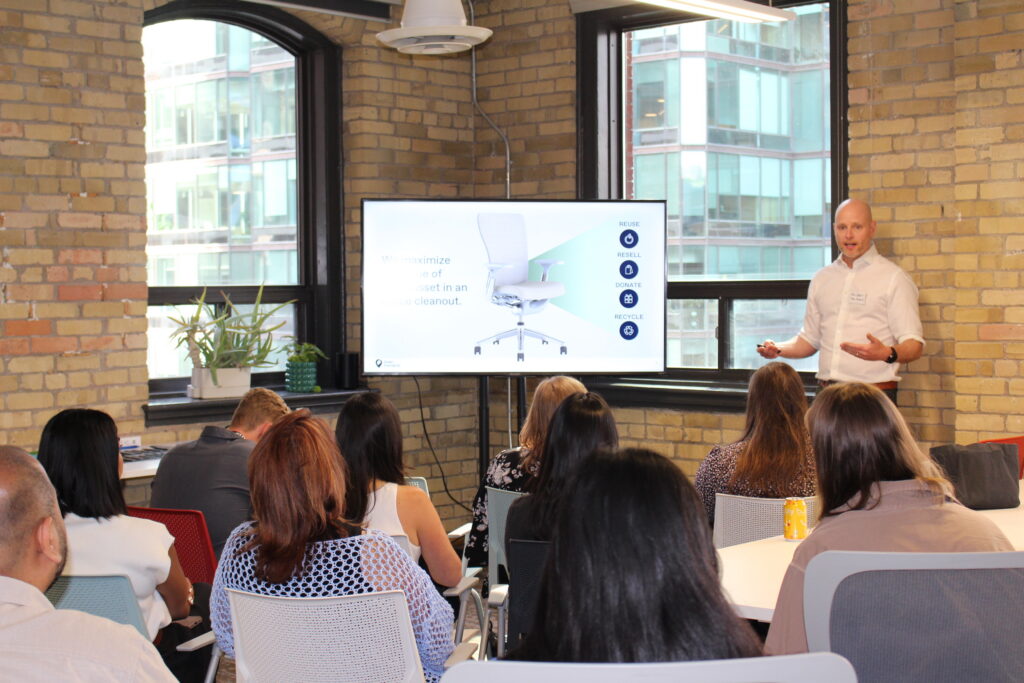
At our Toronto Climate Week event, Can Square Feet Be Circular?, Green Standards invited guests into our downtown offices to talk about what happens when the furniture, fixtures and equipment inside an office has to leave before it is actually done being useful.
The answer starts with a simple question: What’s the next best use?
That question guided the workshop, led by three Green Standards experts who deal with office afterlives every day. Sarah Aronsberg, Head of Community Impact, shared how surplus office furniture supports thousands of non-profits, schools, and community organizations. Rebecca Nolan Samuel explained how higher-value assets can keep working through resale instead of disappearing into a dumpster. And Leah Paster spoke to responsible recycling, landfill diversion, and the reporting that helps clients turn a messy cleanout into measurable ESG progress.
This is the difference between conventional office liquidation and sustainable office decommissioning in Toronto. The old model asks, “How quickly can we get this out of here?” Green Standards says, “Get this out of here quickly to wherever it can do the most good next”
The simple power of office furniture reuse
Sometimes the answer is office furniture reuse within a client’s own portfolio. Sometimes, it’s donation to a local organization that can put desks, chairs, tables, storage, appliances, or fixtures to work immediately. (Our Toronto client OMERS did this to wonderful effect for the MukiBaum Accessibility Centre.) Sometimes, it’s resale through a vetted network. And when an item has truly reached the end of its useful life, it is recycled responsibly instead of being treated like an inconvenience with casters.


To close the evening, participants put their newly acquired circularity knowledge to the test in a game-show-style round of Next Best Use. After learning how office furniture reuse, donation, resale, and recycling decisions are made, guests were challenged to look at real workplace items and decide where each one should go next. It was part quiz, part strategy session, and part reminder that sustainable decommissioning is a series of practical choices, made item by item, at scale. It’s what Green Standards does better than anyone else in the world.
It matters because office interiors carry embodied carbon, and “stuff” changes much faster than buildings do. Throwing usable assets away means wasting the materials, manufacturing, shipping, and installation already invested in them.
Green Standards was founded in Toronto and now provides sustainable office decommissioning services in more than 40 countries. To date, we have managed more than 150 million square feet, diverted more than 128,000 tons from landfill, achieved a 98%+ diversion rate, and generated over $50 million in in-kind charitable donations.
Toronto’s workplaces will keep changing. Our job is to make sure their contents keep working.