How do you sell circularity to skeptical stakeholders? What strategies can we use to make the concept more widely understood and implemented at scale?
At Trellis Impact 26, the conference where innovation powers sustainable business, attendees know that the circular economy can deliver bottom-line benefits. The challenge is making that pitch to everyone else. And that’s exactly what our interactive workshop What Sells Circularity? is designed to do. By asking the assembled sustainability professionals to collaborate on a unique pitch, we’ll surface the pain points that slow circular adoption and the arguments that overcome linear thinking.
First of all, what are we selling?
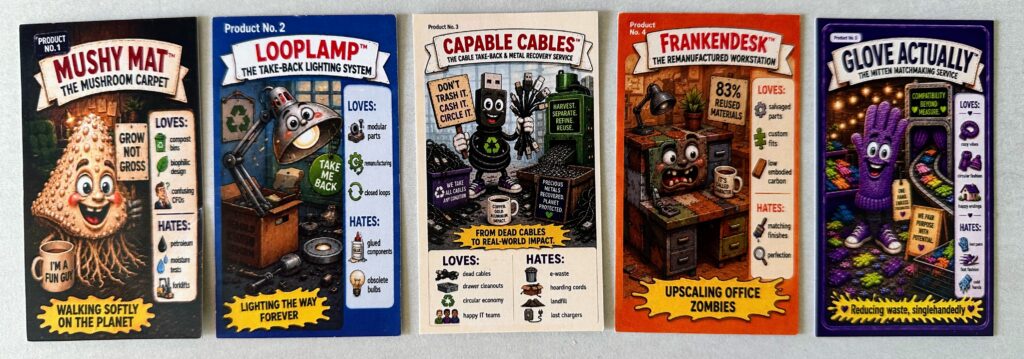
Circular products and services exist across the economy, from the built environment to apparel to tech to consumer packaged goods. To capture this variety, we have five hypothetical business concepts to sell:
- Product 1: Mushy Mat, the mushroom carpet. Modelled after companies that use fungal biotechnology to transform waste into mycelium-based materials, this product imagines a new flooring solution made through mycoremediation.
- Product 2: LoopLamp, the take-back lighting system. Repairability is at the heart of the circular economy, so this imaginary service keeps homes and offices bright in perpetuity.
- Product 3: Capable Cables, the cable takeback and metal recovery service. Every home and office has that box of mismatched chargers, cords, and cables. What if all that e-waste could be traded in for cash?
- Product 4: FrankenDesk, the remanufactured workstation. Workspaces around the world have the same basic form factor, so why can’t spare parts from one fix another?
- Product 5: Glove Actually, the mitten matchmaking service. Unless you still wear your mittens on a string (or you live in a winter-free climate), you’ve likely lost a glove or two. By collecting these perfectly good mismatches and making new pairs, Glove Actually extends the half life of handwear.
Then, who are we selling to?
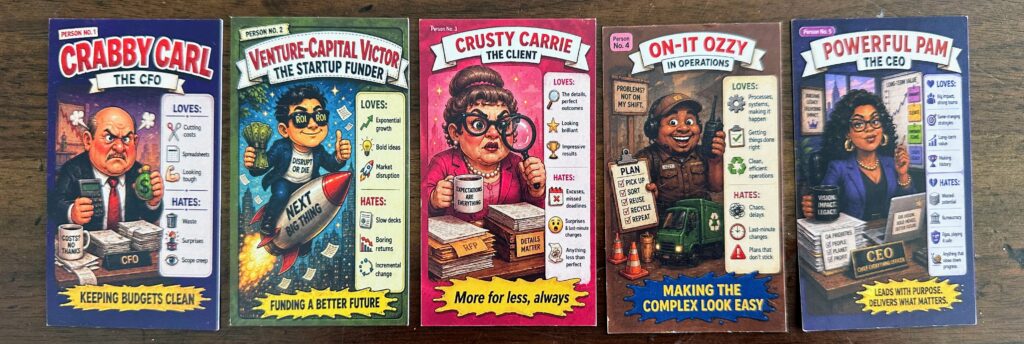
Every successful business idea, even the total no-brainers, requires buy-in from decision makers. In our game, we’ve identified archetypal stakeholders from inside and outside the organization. They include:
- Person 1: Crabby Carl, the CFO. Oh your idea is good for Mother Earth? Carl doesn’t have that column in his spreadsheet. But he’s no fan of waste, and therein may lie your best way of winning over the crabby chief financial officer of your organization.
- Person 2: Venture-Capital Victor. If you’ve got Victor’s ear, you’ve got a promising startup idea on your hands. But how will it translate to exponential growth? Especially in this economy?
- Person 3: Crusty Carrie, the Client. Selling a service means keeping clients happy, as it’s much harder to get a new customer than to keep an existing one coming back. So why should Carrie carry on with you?
- Person 4: On-It Ozzy in Operations. To a project manager, every problem is another project. He has an efficient way of getting things done, which is the box you’d better find a way to squeeze into.
- Person 5: Powerful Pam, the CEO. The buck stops here! Pam can make your idea a reality faster than just about anyone else … if you can win her over!
Finally, why aren’t they buying it?
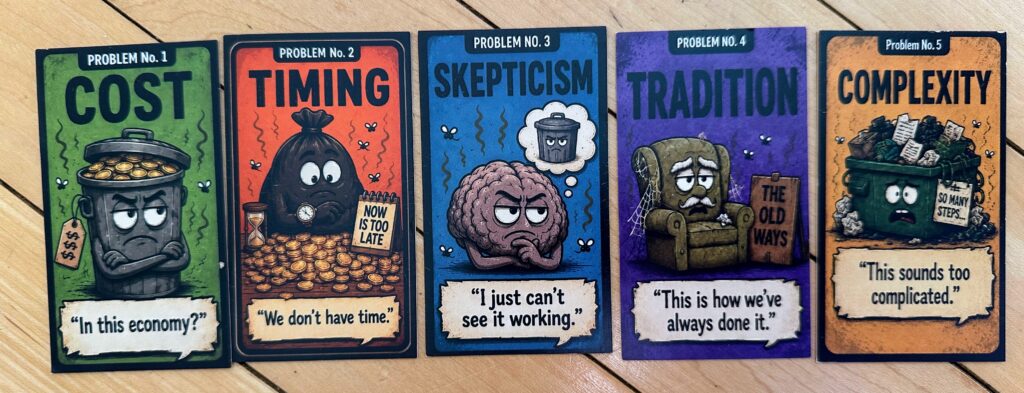
If circularity were easy, it’d already be the basis of the economy. Here are the nasty blockers and barriers that keep loops open and stymie idealistic entrepreneurs the world over. How will you overcome…
- Problem 1: Cost. Money money money, wouldn’t it be funny, if a circular business managed to succeed without making any? No, it would not be funny. It would be sad and all too real. So how will you make the financial case for your product?
- Problem 2: Timing. The thing about linearity is, it’s fast and convenient. Take-make-waste takes no time at all! So how do you convince your stakeholder that it’s taking the longer way to a better outcome?
- Problem 3: Skepticism. Any new idea has its share of skeptics, people who don’t so much kick the tires as deflate them. Show them it’ll work!
- Problem 4: Tradition. Do your best Fiddler on the Roof impression as you sing about TRADITION! The way it was always done, for reasons that date back to before anyone can remember.
- Problem 5: Complexity. If you can’t explain your business to a consumer, you won’t have any consumers. The Keep-It-Simple-Stupid principle applies here as it does everywhere else.
Now, time for the pitch!
.
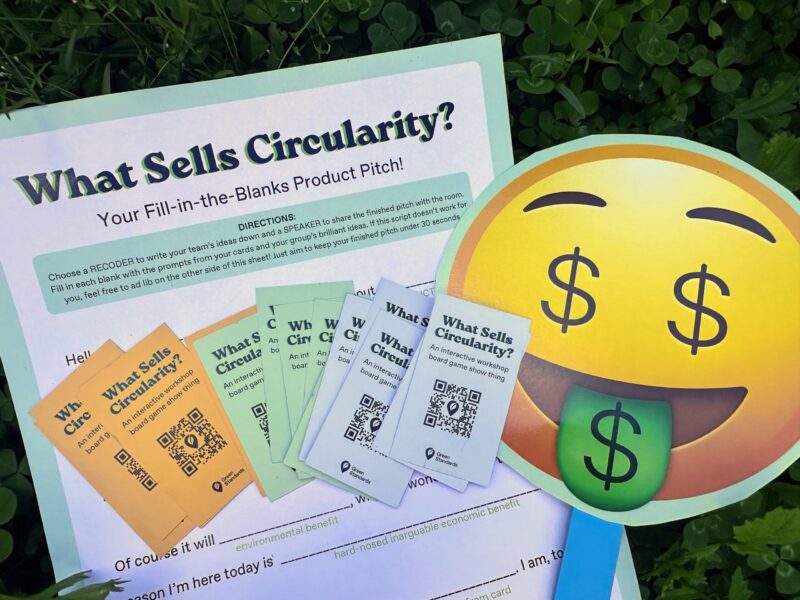
With Person, Product, and Problem, you’re ready to sell some circularity! But how? That’s where our Mad Libs style pitch sheet comes in! Just fill in the blanks with what you’re selling, who you’re selling to, and of course why they need it, and you’re on your way to circular success!
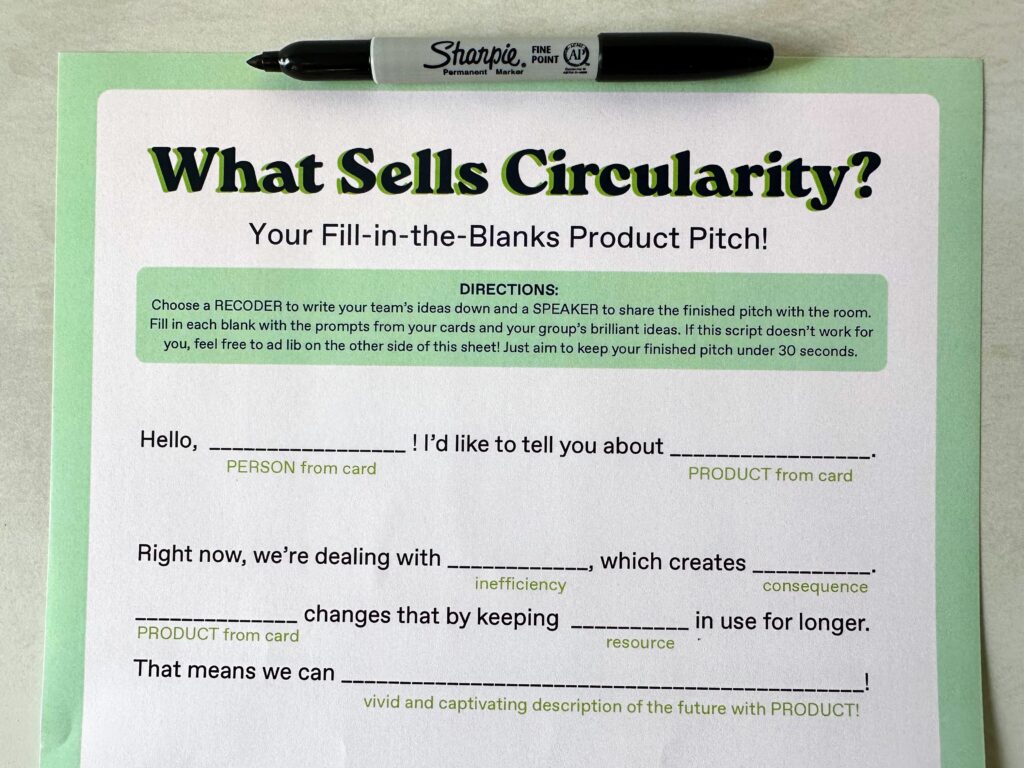
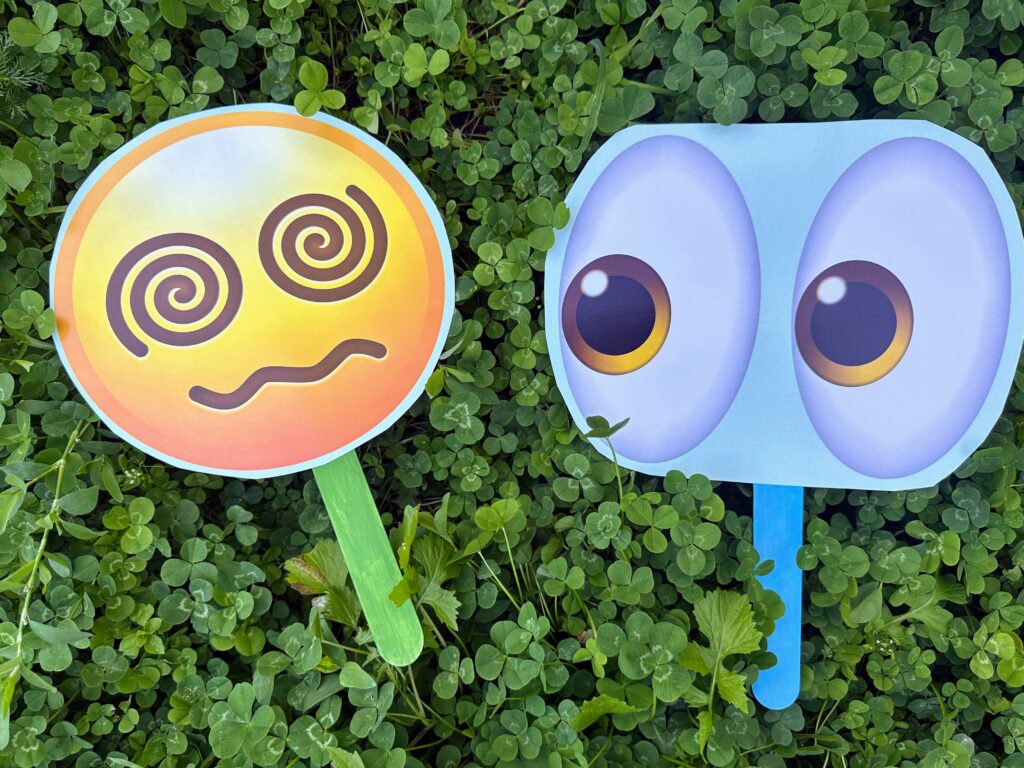
Finally, look for feedback in the form of emoji paddles held up by our esteemed judges. Aim for the 👀, try to set the room on 🔥, and do your best to ensure your circular pitch doesn’t make them pull one of these faces: 😵💫.